Your marketing data
tells you what happened.
I'll tell you why —
and what to do next.
I'm Martin Guzman. I build the measurement systems, attribution models, and analytics infrastructure that help B2B marketing teams stop guessing and start knowing.
Most marketing analytics tells you what happened.
That's a start.
Not a strategy.
Clicks, impressions, conversions — those are outputs. What most teams can't answer is the harder question: what actually caused the result?
Which channel drove that pipeline? Did that campaign create demand, or just claim credit for it? Would those customers have converted anyway?
That's the question I've spent years learning to answer — not with gut feel, but with causal inference, attribution modeling, and the statistical methods that separate signal from noise.
What I Build
Four areas where measurement actually matters — and where gut feel isn't good enough.
Marketing Attribution & Mix Modeling
Multi-touch attribution built for how B2B marketing actually works — long sales cycles, multiple channels, offline touchpoints. I implement and compare model families (Shapley, Markov, Bayesian, predictive) and help you understand which one to trust and why. For longer-horizon strategy, I build Marketing Mix Models using PyMC that account for saturation, adstock effects, and diminishing returns.
For teams that need to defend budget decisions with something more rigorous than last-click.
Causal Inference for Marketing
Running campaigns is easy. Knowing if they worked is hard. I apply causal inference methods — synthetic control, difference-in-differences, regression discontinuity — to measure the true incremental lift of your marketing efforts. I design the measurement framework before you spend the money, so you can answer the question afterward.
For teams that want to run experiments and actually learn from them.
Analytics Infrastructure
GA4, BigQuery, Looker/LookML, Marketo, Fivetran, 6sense — I architect and build the pipelines that connect your marketing stack into a coherent, queryable data layer. No more reconciling spreadsheets. No more "the numbers don't match." Just clean, reliable data your team can actually use.
For teams whose data is scattered, inconsistent, or living in tools that don't talk to each other.
Conversational Analytics — Clarus AI
I built Clarus AI to solve a specific problem: most marketers can't query their own data. Clarus connects directly to your BigQuery analytics data and lets you ask questions in plain English — trends, anomalies, channel breakdowns, cohort behavior — without writing a line of SQL.
For teams who want answers, not tickets to the data team.
Real Problems. Real Results.
The work I'm most proud of is where measurement actually mattered and the stakes were real.
Attribution Across $88M in Pipeline
A B2B tech marketing team needed to understand which of their 15 channels was actually driving pipeline — not just touching it. I built a full multi-touch attribution analysis comparing four model families and surfaced a counterintuitive finding: one channel showed near step-function behavior — below a certain touch threshold it contributed almost nothing, above it conversion rates jumped sharply.
That insight directly reshaped budget allocation.
OOH Campaign Measurement — Synthetic Control
A marketing team ran out-of-home billboard campaigns across three Canadian cities and needed to know if they worked. I applied synthetic control methodology — constructing counterfactual cities from a donor pool — to isolate the causal lift in branded web traffic. The analysis produced directional confidence intervals and a framework for designing better measurement into future OOH buys.
Separated genuine lift from background noise with statistical rigor.
GA4 → BigQuery → Marketo Identity Resolution
A marketing ops team had a gap: email engagement lived in Marketo, web behavior in GA4 — and they couldn't connect the two at the person level. I designed and implemented a Marketo lead ID → GA4 user_id mapping using UTM tokens and GTM, feeding a unified BigQuery layer that enabled post-email behavioral analysis for the first time.
No more reconciling spreadsheets. One clean, queryable data layer.
Isolating True Campaign Lift from Confounders
A B2B SaaS team ran a 20%-off promotional campaign across Q4 and observed a 34% lift in conversions. Leadership wanted to double down on discounts. But the same month also brought Q4 budget season, a product launch, and increased ad spend — classic confounders. I applied a synthetic control + difference-in-differences framework to construct a counterfactual from comparable untreated segments, directly measuring the bias term in E[Y|T=1] − E[Y|T=0] = ATT + BIAS.
True incremental lift was 12%, not 34%. The team avoided over-investing in discounts the following quarter.

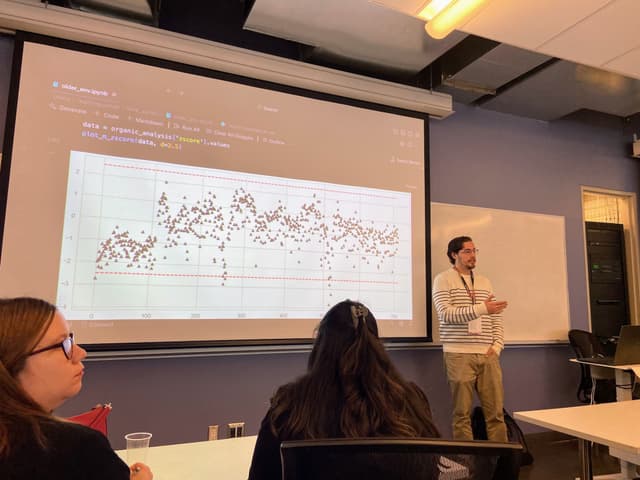
I follow the problems,
not the credentials.
I started in digital marketing in 2014. Google Analytics felt like a superpower — finally, you could measure things. But the more I looked at the data, the more I realized the tools weren't answering the real questions. They were just counting.
So I went deeper. I didn't study statistics — I needed it, so I learned it. Same with Python, SQL, BigQuery, machine learning, causal inference. Every technical skill I have came from hitting a real problem I couldn't solve with what I knew.
I've consulted across the USA, Canada, Mexico, and Finland. Today I work as a senior marketing analytics professional in the B2B AI space and take on select engagements where measurement actually matters. I'm based in Ontario, Canada. I think carefully about causation, I read Borges, and I believe most dashboards are beautiful lies.
Ask your data a question.
Get an actual answer.
Your data team has a backlog. Your dashboard answers last quarter's questions. The marketer with the most urgent question still can't get a straight answer without filing a ticket.
Clarus connects directly to your BigQuery analytics data and turns plain-English questions into insights, charts, and recommendations.
▋
Interactive studies
Explore datasets, run queries, interact with real findings — not just static charts.
Working on a hard
measurement problem?
I take on a small number of consulting engagements each year — the kind where measurement actually matters and the stakes are real.
If you're trying to understand what's driving your pipeline, design a rigorous experiment, or build analytics infrastructure that doesn't fall apart — let's talk.
No pitch deck. Just a conversation about your problem.